Showing posts with label military history. Show all posts

Friday, February 13, 2015

Today in 1861, near Apache Pass in southeastern Arizona,

The earliest military action to be revered with a Medal of Honor award was performed by Colonel Bernard J.D. Irwin, an assistant army surgeon serving in the first major U.S.-Apache conflict.


Near Apache Pass, in southeastern Arizona, Irwin, an Irish-born doctor, volunteered to go to the rescue of Second Lieutenant George N. Bascom, who was trapped with 60 men of the U.S. Seventh Infantry by the Chiricahua Apaches. Irwin and 14 men, initially without horses, began the 100-mile trek to Bascom's forces riding on mules. After fighting and capturing Apaches along the way and recovering stolen horses and cattle, they reached Bascom's forces on February 14 and proved instrumental in breaking the siege.
The first U.S.-Apache conflict had begun several days before, when Cochise, the Chiricahua Apache chief, kidnapped three white men to exchange for his brother and two nephews held by the U.S. Army on false charges of stealing cattle and kidnapping a child. When the exchange was refused, Cochise killed the white men, and the army responded by killing his relatives, setting off the first of the Apache wars.

Although Irwin's bravery in this conflict was the earliest Medal of Honor action, the award itself was not created until 1862, and it was not until January 21, 1894, that Irwin received the nation's highest military honor.

[February 13, 1861]

Thursday, February 12, 2015

Today in 1959, at Amon Carter Field in Fort Worth, Texas,

The United States Air Force retired its last Convair B-36 Peacemaker to become an all-jet bomber force.
 

The Convair B-36 Peacemaker was one of the largest airplanes ever built, and was a key element in maintaining peace during the Cold War with Russia during the 1950s. Originally conceived in 1941 as an intercontinental bomber, it was first produced in the late 1940s, after World War II ended.
Built in Fort Worth, Texas by the Consolidated Vultee Aircraft Corporation (later known
simply as “Convair”), started life as a prop-driven aircraft.  Interestingly, much of the B-36's external skin was made of magnesium, which had a dull color, in contrast to the shiny aluminum used to cover the fore and aft pressurized compartments. During production of the Peacemaker, Convair and the Air Force evolved the plane to the B-36D, B-36F, and B-36H models.
Jets and props are clearly visible.

The four bomb bays could carry up to 86,000 pounds (39,000 kg) of bombs, more than 10 times the load carried by the World War II workhorse, the Boeing B-17 Flying Fortress, and substantially more than the entire B-17's gross weight. The B-36 was not designed with nuclear weaponry in mind, because the mere existence of such weapons was top secret during the period when the B-36 was conceived and designed (1941–46). Nevertheless, the B-36 stepped into its nuclear delivery role immediately upon becoming operational.

A major change to the original, basic B-36 design was the addition of jet engines. Beginning with the B-36D, the Peacemaker added four General Electric J47-GE-19 jet engines, mounted in pods like those used in the Boeing B-47. Ultimately, the Air Force had all earlier B-36 units reconfigured with the jet engines.  In all, 384 Peacemakers were built, all with 6 propellers mounted on the back of the wings, and most with an additional 4 jet engines mounted on the wingtips.

The progression of US bombers up to the B-36.
On this date, the Air Force also received the first Boeing B-52G with larger fuel tanks,
stretching the unrefueled range from 6,000 to 10,000 miles.
[February 12, 1959]

Thursday, February 5, 2015

Today in 1810, in Cadiz, Spain

The Siege of Cádiz began during the Peninsular War.

At the time, Cadiz was a large Spanish naval base of Cádiz and a French army laid siege to the base from 5 February 1810 to 24 August 1812.  Following the occupation of Seville, Cádiz became the Spanish seat of power, and was targeted by 70,000 French troops under the command of the Marshals Claude Victor and Nicolas Jean-de-Dieu Soult for one of the most important sieges of the war.  Defending the city were 2,000 Spanish troops who, as the siege progressed, received aid from 10,000 Spanish reinforcements as well as British and Portuguese troops.
 
 
During the two and a half year siege, the Cortes Generales government in Cadiz (the Cádiz Cortes) drew up a new constitution to reduce the strength of the monarchy (a constitution eventually revoked by Fernando VII).

In October 1810, a mixed Anglo-Spanish relief force embarked on a disastrous landing at Fuengirola. A second relief attempt was made at Tarifa in 1811. However, despite defeating a detached French force of 15,000–20,000 under Marshal Victor at the Battle of Barrosa, the siege was not lifted.
Cadiz served as headquarters for the Spanish fleet.
In 1812, the Battle of Salamanca eventually forced the French troops to retreat from
Andalusia, for fear of being cut off by the allied armies.  Defeat at Cádiz contributed decisively to the liberation of Spain from French occupation, due to the survival of the Spanish government and the use of Cádiz as a jump off point for the Allied forces.
[February 5, 1810]

Wednesday, February 4, 2015

Today in 1941, in Washington, D.C.,

The United Service Organizations, Inc., a civilian agency, was founded.

The USO organization was formed to offer support for U.S. service members and their families, and sent many actors, musicians, and other performers to entertain the troops. Since its inception, the USO has worked in partnership with the Department of Defense (DOD), relying heavily on private contributions and on funds, goods, and services from various corporate and individual donors. Although congressionally chartered, it is not a government agency. The USO operates 160 centers worldwide.
Bob Hope was a fixture of USO tours during the Vietnam War.
During World War II, the USO became the G.I.'s "home away from home" and began a tradition of entertaining the troops that continues today. Involvement in the USO was one of the many ways in which the nation had come together to support the war effort, with nearly 1.5 million Americans having volunteered their services in some way. After it was disbanded in 1947, it was revived in 1950 for the Korean War, after which it also provided peacetime services. During the Vietnam War, USOs were sometimes located in combat zones.
The organization became particularly famous for its live performances called Camp Shows, through which the entertainment industry helped boost the morale of its servicemen and women. Hollywood in general was eager to show its patriotism, and many famous celebrities joined the ranks of USO entertainers. They entertained in military bases at home and overseas, sometimes placing their own lives in danger, by traveling or performing under hazardous conditions.

Today the USO has over 160 locations around the world in 14 countries (including the U.S.) and 27 states. In 2009, USO centers served 7.7 million visitors. That number climbed to more than 8 million in 2011.

[February 4, 1941]

Monday, February 2, 2015

Today in 1943, on the northern outskirts of Stalingrad, Soviet Union,

At Stalingrad, the remnants of the German 6th Armee under General Strecker in the northern pocket of the Kessel ceased fighting and surrendered to the Red Army.

German troops march into Soviet captivity.
The Battle of Stalingrad began in the summer of 1942 with a German assault on the city, a major industrial center and a potential strategic coup, and an early determination that the capture of the city would be swift and relatively easy.  However, repeated attacks by the 6th Army, under General Friedrich von Paulus, and part of the 4th Panzer Army, under General Ewald von Kleist, could not break past the determined defense of the city by the Soviet 62nd Army.  German forces pushed the Soviets almost to the Volga River in mid-October and eventually encircled Stalingrad (before later becoming encircled themselves).
 
Stubborn, resourceful defenders, diminishing resources, partisan guerilla attacks, and the harsh Russian winter were already taking their toll on the German forces when, on November 19, the Soviets launched a massive counteroffensive.  The Soviet attack began with a massive artillery bombardment of the German positions and ended with the Soviets encircling the enemy, launching pincer movements from north and south simultaneously, eventually making the German position untenable.

Von Paulus surrenders.
Surrender was the German’s only hope for survival, but Hitler refused to consider it: " Surrender is out of the question.  The 6th Army will hold its positions to the last man and the last round."  
 
In fact, Von Paulus held out until January 31, 1943, when he finally surrendered. Of more than 280,000 men under Paulus' command, half were already dead or dying, about 35,000 had been evacuated from the front, and the remaining 91,000 were hauled off to Soviet POW camps.  Only about 5,000 would ever return to Germany after the war.
 
Soviet troops celebrate their victory.
Pockets of German belligerence continued until February 2.

[February 2, 1943]

Sunday, February 1, 2015

Today in 1800, in the open sea of the Atlantic Ocean

The USS Constellation engaged in a decisive battle with the French vessel La Vengeance.

USS Constitution is still an active warship in the US Navy.
An undeclared war between the United States and France, the Quasi-War was the result of disagreements over treaties and America's status as a neutral in the Wars of the French Revolution. Fought entirely at sea, the Quasi-War was largely a success for the fledgling US Navy as its vessels captured numerous French privateers and warships, while only losing one of its vessels. By late 1800, attitudes in France shifted and hostilities were concluded by the Treaty of Mortefontaine.
 
 
The Quasi-War was officially fought from July 7, 1798, until the signing of the Treaty of Mortefontaine on September 30, 1800. French privateers had been preying on American shipping for several years prior to the beginning of the conflict.

The two most noteworthy battles of the conflict involved the 38-gun frigate USS Constellation. Commanded by Thomas Truxtun, Constellation sighted the 36-gun French frigate L'Insurgente on February 9, 1799. The French ship closed to board, but Truxtun used Constellation's superior speed to maneuver away, raking L'Insurgente with fire. After a brief fight, Capt. M. Barreaut surrendered his ship to Truxtun.
 
Almost a year later, on February 2, 1800, Constellation encountered the 52-gun frigate La Vengeance. Fighting a five-hour battle at night, the French ship was pummeled, but was able to escape in the darkness.
[February 1, 1800]

Saturday, January 31, 2015

Today in 1606, in London, England

Guy Fawkes was hanged, drawn and quartered.

Today, England celebrates November 5 as “Guy Fawkes Day” in commemoration of the botched attack on the English Parliament by a group of anti-government conspirators who hoped to blow up the Parliament building in the infamous "Gunpowder Plot."  Ironically, Fawkes was not one of the original conspirators and actually was a late addition to the group.


Born a Protestant in 1570, Fawkes enlisted in the Spanish army in the Netherlands around 1593, shortly after converting to Catholicism. Co-conspirators Robert Catesby, Thomas Winter, Thomas Percy and John Wright enlisted Fawkes as a ringer, reasoning that his military skills — he had participated in the 1595 capture of Calais, France — and his anonymity as a foreign soldier made him an ideal candidate to help execute their plan.

Fawkes' henchmen were zealous Catholics who believed that by beheading the government, they might usher in a new era of Catholicism in Protestant England. Led by Catesby, they hatched a plan to explode gunpowder under Parliament during a state opening, when King James I, his queen, and other family members and government leaders were inside. The plot was set for Nov. 5, 1605, and in the preceding days, the conspirators rented a cellar underneath the building, where Fawkes stashed at least 20 barrels of gunpowder.
Things didn't go according to plan. The plotters sought wider support, and, as the story goes, one of the individuals to whom they reached out alerted his brother-in-law, a lord, not to attend Parliament on Nov. 5. The building was searched, and Fawkes was apprehended along with his stockpile of gunpowder. Tortured on the rack, he revealed the names of his co-conspirators. Some of them were killed while resisting arrest; others, including Fawkes, pled not guilty and went to trial, where they were convicted of high treason. In January, 1606, the remaining conspirators were hanged, drawn and quartered. Parliament immediately established Nov. 5 as a day of celebration.

[January 31, 1606]

Friday, January 30, 2015

Today in 1912, in New York City,

Author and historian Barbara Tuchman was born.

 
Ms. Tuchman is a two-time Pulitzer Prize winner who is best known for her book The Guns of August (1962), a historical analysis of early World War I.  She earned her first Pulitzer in 1963.   She went on to win another Pulitzer in 1970 for Stilwell and the American Experience in China, 1911-45, a book about the relationship between America and China during World War II. Tuchman died on February 6, 1989, in Greenwich, Connecticut.
[January 30, 1912]

Monday, January 26, 2015

Today in 1863, in Washington, D.C.

Union General Joseph Hooker assumed command of the Army of the Potomac.


Gen. "Fightin' Joe' Hooker
Following Ambrose Burnside's disastrous tenure as commander, including the debacle at Fredericksburg, Virginia, President Lincoln realized the demoralized Union army desperately needed a new leader.  Hooker, a West Point graduate, was a veteran of the Seminole War and the Mexican War, and served in the American West in the 1850s. When the Civil War erupted, Hooker was named brigadier general in the Army of the Potomac. He quickly rose to division commander, and distinguished himself during the Peninsular Campaign of 1862. He also continued to build his reputation as a hard drinker and womanizer. Hooker received command of the First Corps in time for the Second Battle of Bull Run, Virginia, in August 1862 and his corps played a major role in the Battle of Antietam in Maryland in September of that year.

Accidentally saddled with the sobriquet “Fighin’ Joe” when a newspaper poked fun at the General’s notoriously thin skin, General Hooker would forever after be known as Fightin’ Joe Hooker.
Battle of Chancellorsville
When he took charge, Hooker first had to deal with the sagging morale of the army. He reorganized his command and instituted a badge system, where each division had its own unique insignia. This helped to build unit pride and identity, and Hooker led a re-energized army into Virginia in April 1863. Hooker's appointment was part of President Abraham Lincoln's frustrating process of finding a winning general in the East. After Irwin McDowell, George McClellan, John Pope, McClellan again, and then Burnside, Lincoln hoped Hooker could defeat Confederate General Robert E. Lee and the vaunted Army of Northern Virginia.

Gen. George Meade
However, it was too tall an order for a man like Hooker. In May 1863, Hooker clashed with Lee at the Battle of Chancellorsville, Virginia, and the Union army suffered a decisive and stunning defeat. Lincoln's search for an effective commander continued.  When Hooker sensed that his Commander in Chief (and the army itself) had lost confidence in him, he foolishly tendered an offer of resignation (which he did not believe Lincoln would accept).  But, Lincoln knew Hooker was not the man for the job, accepted the resignation, and, much to his surprise, appointed George Meade the new commander, just days before the pivotal battle at Gettysburg, Pennsylvania.

[January 26, 1863]

Friday, January 23, 2015

Today in 1945, along the northern coast of East Prussia,

The German Kriegsmarine began the evacuation by sea of hundreds of thousands of civilian refugees from East Prussia and the Danzig area.

Desperate Wehrmacht troops evacuating Danzig.
The Soviet Red Army advance was virtually unstoppable, the German operation against the US and British in the West had failed, and East Prussia's land communications with the rest of the Reich had been completely severed.

By 1945, the Kriegsmarine was a shadow of its former self.
The Reich did not have much longer to survive.
[
January 23, 1945]

Thursday, January 22, 2015

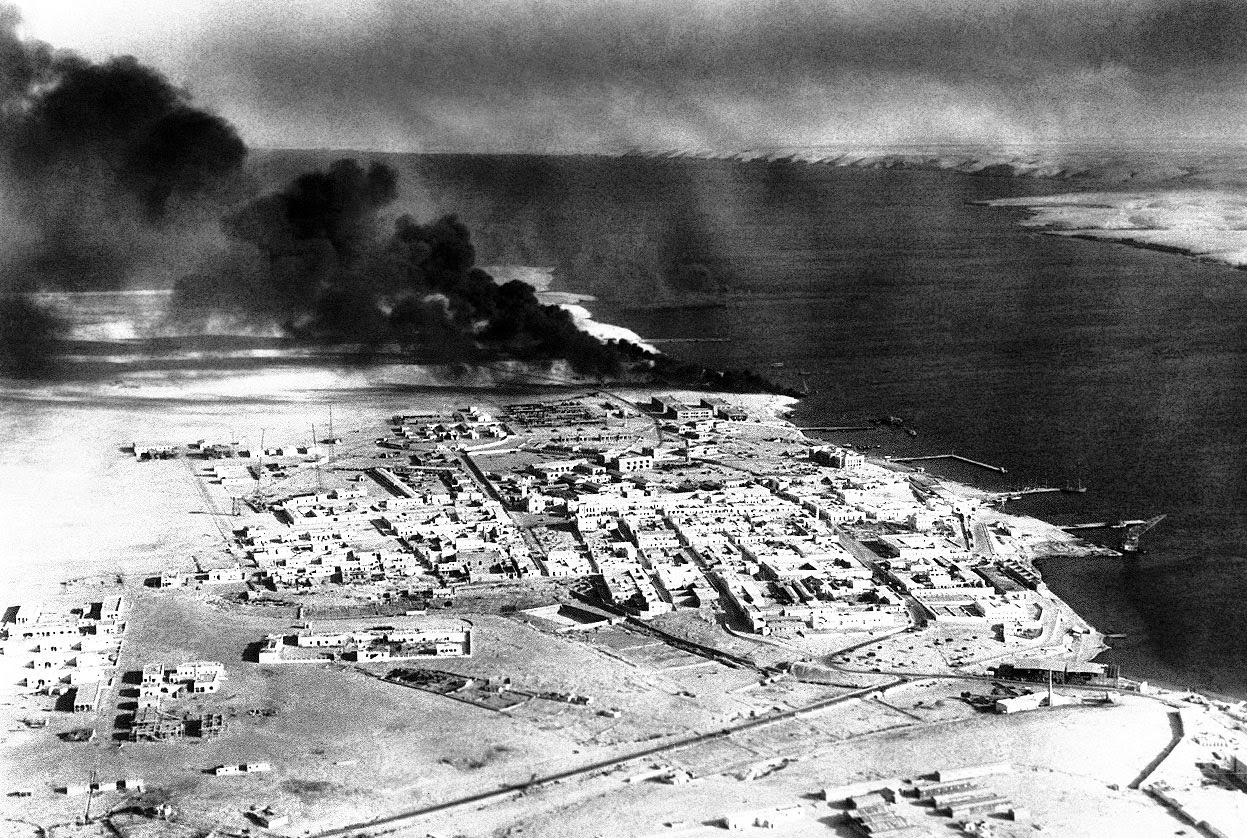
Today in 1941, in Tobruk, Libya

British and Commonwealth forces entered the port city, capturing it and taking tens of thousands of Italian occupiers taken prisoner.

Tobruk's port was more important than the city itself.
Less than a year earlier, Italy had declared war on Great Britain in June 1940. At that time, Gen. Rodolfo Graziani had almost 10 times the number of men in Libya than the British forces in Egypt under Gen. Archibald Wavell, who was commissioned to protect the North African approaches to the Suez Canal. A vast western desert stretched between the antagonists, who sat for months without confrontation. During that time, Italian forces passed into Egypt-but by that point Britain had reinforced its own numbers and decided to make a first strike.
Tobruk would change hands several times during the war.
On December 9, Maj. Gen. Richard Nugent O'Connor launched a westward offensive from Mersa Matruh, in Egypt. Thirty thousand Brits warred against 80,000 Italians-but the British had the advantage of 275 tanks to the Italians' 120. Within three days, 40,000 Italian prisoners were taken. The battle marked the beginning of the end of the Italian occupation of North Africa.

Italian artillery was among the spoils captured by the British.
General O'Connor then began a sweep of Italian positions in Libya. Under his direction in early January 1941, the British 7th Royal Tank Regiment drove westward from Bardia, which it had just taken from the Italians, with the intention of isolating Tobruk until the 6th Australian Division could aid in an assault. The attack on the coastal fortress of Tobruk was finally launched on the 21st and it fell the next day, yielding 30,000 Italian prisoners, 236 guns, and 87 tanks. The 7th Royal Tank Regiment was a remarkable unit, winning a quick series of battles in Libya despite a paucity of resources.
Rommel and the Afrika Korps arrived in the nick of time.
However, the British victory was short-lived as the unrelenting string of Italian catastrophes led Adolf Hitler to the conclusion that the Italian would lose all of North Africa if they were no reinforced by German forces.  Rommel and the Afrika Korps soon arrived.

[January 22, 1941]

Wednesday, January 21, 2015

Today in 1954, on the Thames River in Connecticut

USS Nautilus (SSN-571), the world's first operational nuclear-powered submarine, was christened by Mamie Eisenhower and launched.

 
Commissioned on September 30, 1954 under the command of Commander Eugene P. Wilkinson, USN, the vessel was the first submarine to complete a submerged transit to the North Pole on August 3, 1958. Sharing names with the submarine in Jules Verne's Twenty Thousand Leagues Under the Sea, and named after another USS Nautilus (SS-168) that served with distinction in World War II, Nautilus was authorized in 1951 and launched in 1954. Because her nuclear propulsion allowed her to remain submerged far longer than diesel-electric submarines, she broke many records in her first years of operation, and traveled to locations previously beyond the limits of submarines. In operation, she revealed a number of limitations in her design and construction. This information was used to improve subsequent submarines.


Nautilus was decommissioned in 1980 and designated a National Historic Landmark in 1982. The submarine has been preserved as a museum of submarine history in Groton, Connecticut, where the vessel receives some 250,000 visitors a year.

[January 21, 1954]

Today in 1824, in Clarksburg, Virginia

Thomas Jonathon (later “Stonewall”) Jackson was born.

CSA General "Stonewall" Jackson
During the American Civil War, Jackson sided with the South and joined the Army of the Confederate States of America as a commissioned officer at the regimental level. 
Jackson at First Bull Run where he earned his nickname
Jackson, a devout Christian, was a West Point graduate who served in the Mexican War then resigned to teach at the Virginia Military Institute. Serving with the Rebel army, he became a Brigadier General, earning his nickname of “Stonewall” at the first battle of Bull Run as his troops held firm while others wavered. "There is Jackson standing like a stone wall," General Bee, a fellow general, commented.
Jackson, with Lee and Davis, is immortalized at Stone Mountain, Georgia
During the Battle of Chancellorsville (and not long before Lee’s invasion of the North and the Battle of Gettysburg), Jackson was shot by jittery confederate troops while he was riding with other officers and inspecting the lines in the dark.  "I have lost my right arm," lamented General Lee upon his death.  Jackson was missed at Gettysburg and many remain convinced that had he been present the outcome of that pivotal battle would have been very different.
[January 21, 1824]

Monday, January 19, 2015

Today in 1419, in Upper Normandy, France

The city of Rouen surrendered to Henry V of England.

The capture of Rouen completed Henry V's conquest of Normandy.
Fought between 1337 and 1453, the Hundred Years' War saw England and France battle for the French throne.  Beginning as a dynastic war in which Edward III of England attempted to assert his claim to the French throne, the Hundred Years' War also saw English forces attempt to regain lost territories on the Continent.  Though initially successful, English victories and gains were slowly undone as French resolve stiffened. 

Henry V
During the Lancastrian phase of the War, Richard II was deposed by Henry IV in 1399 in England and Charles VI was plagued by mental illness in France.  While Henry desired to mount campaigns in France, issues with Scotland and Wales prevented him from moving forward.  The war was renewed by his son Henry V in 1415 when an English army landed and captured Harfleur. 

The Hundred Years' War saw the decline of the mounted knight.
As it was too late in the year to march on Paris, he moved towards Calais and won crushing victory at the Battle of Agincourt.  Over the next four years, he captured Normandy and much of northern France.  Meeting with Charles in 1420, Henry agreed to the Treaty of Troyes by which he agreed to marry the French king's daughter and have his heirs inherit the French throne. 

[January 19, 1419]

Saturday, January 17, 2015

Today in 1991, along the Iraqi eastern and southern frontier

Operation Desert Storm began.

American and Allied air power controlled the skies over the battlefield.
Desert Storm began when aircraft from British, American, Kuwait, French and Saudi bomb military and strategic targets in Iraq, including an oil refinery and Baghdad airport. 

Iraqi armored units were decimated.
Defending Iraqi Army units, most of which had dug into fixed positions, were ill-prepared for the ferocity of the onslaught that was being unleashed against them.  In the aftermath of the attacks, it was hard to believe how quickly the war was concluded, how light had been the Allied casualties (the feared chemical and biological weapons had not been used by the Iraqi's), and how complete was the the victory against the defending armed forces that had sacked Kuwait weeks earlier. However, the long sought and effective peace the Allies had envisioned proved elusive and it wasn't long before a second war was underway.

[January 17, 1991]

Friday, January 16, 2015

Today in 1945, in Berlin, Germany,

Adolf Hitler moved into the Führerbunker.

Der Fuhrer

Hitler would spend the rest of his life), 105 days, in the bunker while overwhelming Soviet infantry and armored forces surrounded and eventually captured the German capital. It became the centre of the Nazi regime until the last week of World War II in Europe. Hitler married Eva Braun here during the last week of April 1945, shortly before they committed suicide.
The bunker as it looked after it was captured by the Soviets
The Führerbunker (English: "Leader's bunker") was an air-raid shelter located near the Reich Chancellery in Berlin, Germany. It was part of a subterranean bunker complex constructed in two phases which were completed in 1936 and 1944. It was the last of the Führer Headquarters
(Führerhauptquartiere) used by Adolf Hitler.
After the war both the old and new Chancellery buildings were levelled by the Soviets. Despite some attempts at demolition, the underground complex remained largely undisturbed until 1988–89. During reconstruction of that area of Berlin, the sections of the old bunker complex that were excavated were for the most part destroyed. The site remained unmarked until 2006, when a small plaque with a schematic diagram was installed. Some corridors of the bunker still exist, but are sealed off from the public.

[January 16, 1945]


Wednesday, January 14, 2015

Today in 1960, in West Germany,

Elvis Presley was promoted to Sergeant (E-5).

Sgt. Presley showing off his new stripes.
Elvis entered the United States Army at Memphis, Tennessee, on March 24, 1958, and then spent three days at the Fort Chaffee, Arkansas, Reception Station. He left active duty at Fort Dix, New Jersey, on March 5, 1960, and received his discharge from the Army Reserve on March 23, 1964.

During his active military career Mr. Presley served as a member of two different armor battalions. Between March 28 and September 17, 1958, he belonged to Company A, 2d Medium Tank Battalion, 37th Armor, stationed at Fort Hood, Texas. During this assignment he completed basic and advanced military training.

Elvis' overseas service took place in Germany from October 1, 1958, until March 2, 1960, as a member of the 1st Medium Tank Battalion, 32d Armor. For the first five days of that period he belonged to Company D of the battalion, and thereafter to the battalion's Headquarters Company at Friedberg.

While in Germany Elvis wore the shoulder sleeve insignia of the 3d Armored Division.

[January 14, 1960]

Tuesday, January 13, 2015

Civil War Trust Completes Memorable 2014

The cause of battlefield preservation took great strides forward in 2014, as the Civil War Trust, America’s premier battlefield preservation organization, announced several landmark projects, and laid the groundwork for continued success beyond the conclusion of the national Civil War sesquicentennial commemoration.  Through the generosity of individual donors, coupled with strategic partnerships with government officials and nonprofit groups across the country, the Trust protected more than 2,300 acres of battlefield land in 2014, eclipsing 40,000 total acres saved by the organization at 122 historic sites in 20 states.

 
“A generation from now, I believe that 2014 will be remembered as the year when the conceivable scope of battlefield preservation exploded,” remarked Trust president James Lighthizer.  “This was the year that we demonstrated, in multiple ways, the tremendous level of public support for protection of hallowed ground as outdoor classrooms and living memorials to the sacrifices of
America’s military.”
Working closely in cooperation with willing landowners and preservation partners, the Trust completed 45 transactions at 26 individual battlefields in 10 states. The battlefields where land was preserved in 2014:  Appomattox Court House, Va.; Bentonville, N.C.; Brandy Station, Va.; Cedar Creek, Va.; Cold Harbor, Va.; Davis Bridge, Tenn.; Franklin, Tenn.; Gettysburg, Pa.; Glendale, Va.; Glorieta Pass, N.M.; Harpers Ferry, W.Va.; Kelly’s Ford, Va.; Mansfield, La.; Mill Springs, Ky.; North Anna, Va.; Petersburg, Va.; Port Republic, Va.; Rappahannock Station, Va.; Ream’s Station, Va.; Richmond, Ky.; Shepherdstown, W.Va.; Shiloh, Tenn.; South Mountain, Md.; Stones River, Tenn.; Trevilian Station, Va.; and Vicksburg, Miss.


The Antietam battlefield in Maryland
With the October closing of the 654-acre historic Fontaine Farm at North Anna — a property encompassing nearly the entire scene of combat on May 23, 1864 — the Trust surpassed 40,000 acres saved in the organization’s history. In November, the Trust embarked on a large preservation opportunity at Chancellorsville, seeking to raise nearly $500,000 to save 479 acres associated
with Confederate Lt. Gen. Thomas “Stonewall” Jackson’s flank attack. Facilitating these types of landmark transactions was the Trust’s ongoing sesquicentennial fundraising effort, Campaign 150, which, in April, met its original $40 million goal before being extended to an unprecedented $50 million target.
Proving that acreage is not the only measure of a preservation project’s significance, in July, the Trust announced a $5.5 million national fundraising campaign to save 4.1 acres in Gettysburg, Pa. The property played a key role in combat on July 1, 1863, and includes several historic buildings — most notably the Mary Thompson House, used throughout the remainder of the battle as Gen. Robert E. Lee’s headquarters.

The most significant developments in battlefield preservation during 2014 came near the year’s close. On Veterans Day, the Trust announced the launch of Campaign 1776, ww.campaign1776.org, the first-ever national initiative to preserve and interpret the battlefields of the Revolutionary War and the War of 1812. The new effort’s first project involves assisting the State of New Jersey in the protection of four acres on the Princeton Battlefield, scene of George Washington’s first victory over British forces on January 3, 1777. Campaign 1776 received a major boost on December 12, when Congress passed legislation to extend federal matching grants for battlefield protection through 2021 and, for the first time, make sites from other conflicts eligible for what had previously been a Civil War-only program.

“The extension of this grant program mirrors our reasoning for the creation of Campaign 1776,” said Trust president James Lighthizer. “All of these American battlefields are sacred places — living memorials to this nation’s brave soldiers, past, present and future — and it is up to us to ensure their protection.”
The battle of Antietam in September 1862

The Trust’s preservation success in 2014 would not have been possible without the dedication of Trust partners, including:  American Battlefield Protection Program, National Park Service, Bentonville Battlefield State Historic Site, City of Franklin (TN), County of Chesterfield (VA) Parks and Recreation, Department of Agriculture Farm and Ranch Lands Protection Program, Jefferson County Historic Landmarks Commission, Kentucky Heritage Council, Madison County (KY) Fiscal Court,
Louisiana Office of State Parks, Maryland Department of Transportation, Maryland Department of Natural Resources, Mississippi Department of Archives and History, Municipality of Princeton (NJ), New Jersey State Parks, Forests and Historic Sites, New Mexico Department of Cultural Affairs-Historic Preservation Division, North Carolina Department of Cultural Resources, Pennsylvania Historical and Museum Commission-Bureau for Historic Preservation, Tennessee Historical Commission, Tennessee Civil War Sesquicentennial Commission, Tennessee Department of Transportation, Virginia Department of Historic Resources, Virginia Department of Conservation and Recreation and Virginia Department of Transportation.  Numerous organizations also contributed to these preservation successes, including:  Averasboro Battlefield Commission, Battle of Richmond Association, Brandy Station Foundation, Franklin’s Charge, Central Maryland Heritage League, Central Virginia Battlefields Trust, Friends of Shiloh National Military Park, Friends of Vicksburg National Military Park and Campaign, Friends of Wilderness Battlefield, Gettysburg Foundation, Glorieta Battlefield Preservation Society, Journey Through Hallowed Ground, Land Conservancy of Adams County, Land Trust for Tennessee, Land Trust of the Eastern Panhandle, Manassas Battlefield Trust, Maryland Environmental Trust, Maryland Historical Trust, Mill Springs Battlefield Association, National Parks Conservation Association, New Mexico Land Conservancy, Piedmont Environmental Council, Princeton Battlefield Society, Richmond Battlefields Association, Save Historic Antietam Foundation, Silver Companies, Shenandoah Valley Battlefields Foundation, Shepherdstown Battlefield Preservation Association, Trevilian Station Battlefield Foundation and Wallace Foundation.


“These are among the generous individuals and organizations who continue to stand by the Trust and our members — year in and year out — to save America’s hallowed ground,” Lighthizer said. “Our job would be a whole lot harder without the tireless efforts of these leaders, along with many of our elected officials who fight — tooth and nail — for programs essential to our efforts.”
In addition to its land acquisition successes, the Trust continues promoting greater appreciation and understanding of the Civil War through its innovative educational programs and digital offerings.  In 2014, the group’s flagship website, www.civilwar.org, received more than 5.8 million unique visits — an increase of 30 percent from 2013.  A popular new online feature was the War Department™ video series, an ongoing effort designed to move past lists of names and dates, encouraging viewers to analyze the broader impact of historical events.  Classroom educators benefited from two new Trust programs: the Teachers Regiment, a virtual community of classroom educators, museum professionals, librarians, tour guides and other public historians eager to raise the level of history instruction nationwide; and the Field Trip Fund, a scholarship fund to assist teachers in planning and paying for student trips to historic sites.


Antietam preservation
The Trust also continues to earn accolades for its sound fiscal management and commitment to top-notch donor relations, renewing its Better Business Bureau Wise Giving Alliance accreditation and receiving a prestigious Top-Rated Award by GreatNonprofits, the leading provider of user reviews about nonprofit organizations. In addition, the Trust maintained its 4-star rating from Charity Navigator, America’s leading charity evaluator, for a fifth straight year — an honor bestowed on only four percent of charities assessed by that organization.  Further, the Trust’s membership magazine, Hallowed Ground, again earned top honors for outstanding quality through the APEX Awards for Publication Excellence — its sixth-consecutive Grand Award.

The Civil War Trust is the largest and most effective nonprofit organization devoted to the preservation of America’s hallowed battlegrounds.  Although primarily focused on the protection of Civil War battlefields, through its Campaign 1776 initiative, the Trust also seeks to save the battlefields connected to the Revolutionary War and War of 1812.  To date, the Trust has preserved more than 40,000 acres of battlefield land in 20 states.  Learn more at www.civilwar.org.


Sunday, January 11, 2015

Today in 1879, in Africa on the border of Zululand and the Transvaal

The Anglo-Zulu War, fought between the British and the Zulus, began with the British invasion of Zululand.

British forces entered Zululand under thinly veiled pretexts.
Following Lord Carnarvon's successful introduction of federation in Canada, it was thought that similar political effort, coupled with military campaigns, might succeed with the African kingdoms, tribal areas and Boer republics in South Africa.

British regulars in their distinctive red coats.
In 1874, Sir Henry Bartle Frere was sent to South Africa as High Commissioner for the British Empire to bring such plans into being. Among the obstacles were the presence of the independent states of the South African Republic and the Kingdom of Zululand and its army. Frere, on his own initiative, without the approval of the British government and with the intent of instigating a war with the Zulu, had presented an ultimatum on December 11, 1878, to the Zulu king Cetshwayo with which the Zulu king could not comply. Bartle Frere then sent Lord Chelmsford to invade Zululand.

Early Zulu victories shocked the British, but also strengthened their resolve.
The war is notable for several particularly bloody battles, including a stunning opening victory by the Zulu at the Battle of Isandlwana, as well as for being a landmark in the timeline of imperialism in the region. The war eventually resulted in a British victory and the end of the Zulu nation's independence.
[January 11, 1879]

Wednesday, January 7, 2015

Today in 1871, on the outskirts of Paris, France

Attacking Prussian forces began the bombardment of Paris during the Franco-Prussian War.


Eventually, Prussian forces captured the French capital, ending the war with a Prussian victory and establishing Germany as a country.
 

Ironically, the war and German victory set in motion an ongoing conflict that would eventually engulf all of Europe and the rest of the world in World War I and World War II.