Showing posts with label Afrika Korps. Show all posts

Thursday, January 22, 2015

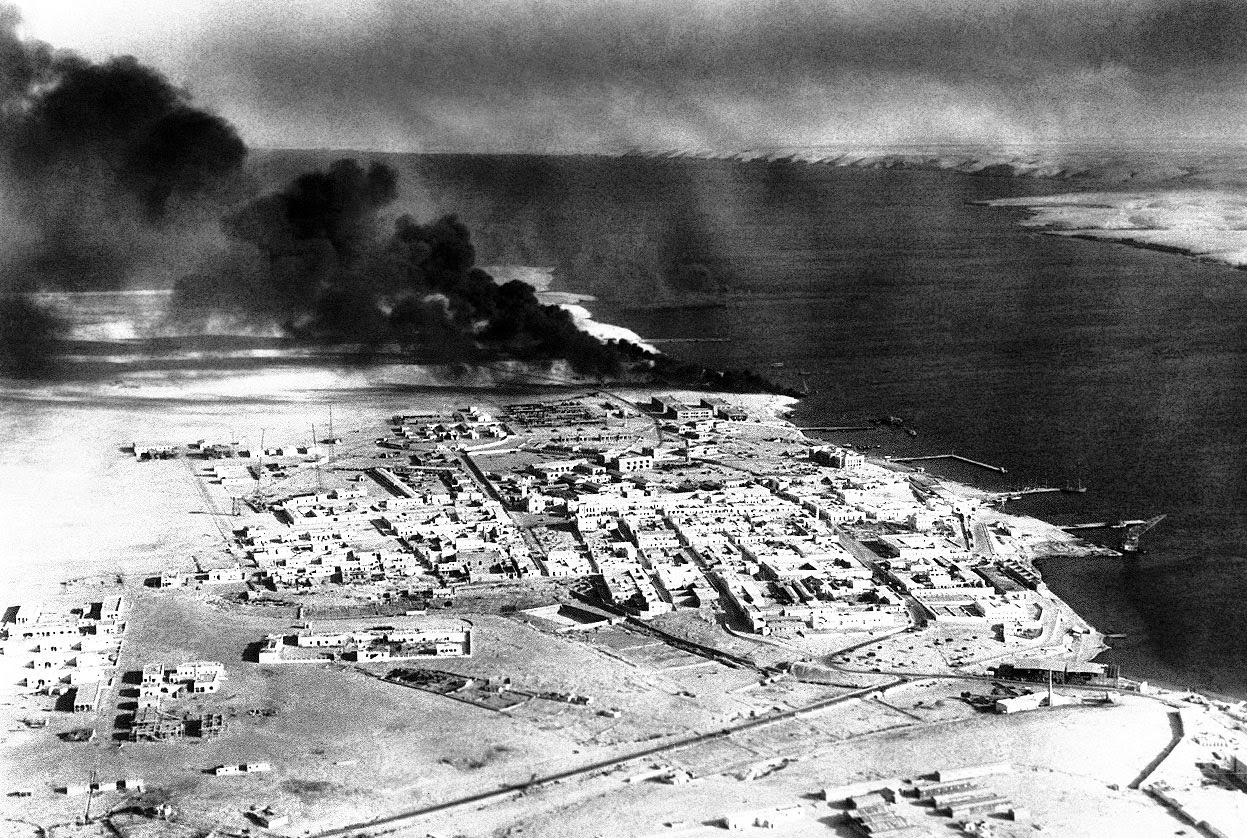
Today in 1941, in Tobruk, Libya

British and Commonwealth forces entered the port city, capturing it and taking tens of thousands of Italian occupiers taken prisoner.

Tobruk's port was more important than the city itself.
Less than a year earlier, Italy had declared war on Great Britain in June 1940. At that time, Gen. Rodolfo Graziani had almost 10 times the number of men in Libya than the British forces in Egypt under Gen. Archibald Wavell, who was commissioned to protect the North African approaches to the Suez Canal. A vast western desert stretched between the antagonists, who sat for months without confrontation. During that time, Italian forces passed into Egypt-but by that point Britain had reinforced its own numbers and decided to make a first strike.
Tobruk would change hands several times during the war.
On December 9, Maj. Gen. Richard Nugent O'Connor launched a westward offensive from Mersa Matruh, in Egypt. Thirty thousand Brits warred against 80,000 Italians-but the British had the advantage of 275 tanks to the Italians' 120. Within three days, 40,000 Italian prisoners were taken. The battle marked the beginning of the end of the Italian occupation of North Africa.

Italian artillery was among the spoils captured by the British.
General O'Connor then began a sweep of Italian positions in Libya. Under his direction in early January 1941, the British 7th Royal Tank Regiment drove westward from Bardia, which it had just taken from the Italians, with the intention of isolating Tobruk until the 6th Australian Division could aid in an assault. The attack on the coastal fortress of Tobruk was finally launched on the 21st and it fell the next day, yielding 30,000 Italian prisoners, 236 guns, and 87 tanks. The 7th Royal Tank Regiment was a remarkable unit, winning a quick series of battles in Libya despite a paucity of resources.
Rommel and the Afrika Korps arrived in the nick of time.
However, the British victory was short-lived as the unrelenting string of Italian catastrophes led Adolf Hitler to the conclusion that the Italian would lose all of North Africa if they were no reinforced by German forces.  Rommel and the Afrika Korps soon arrived.

[January 22, 1941]

Friday, December 12, 2014

It's about time The Military Minute made it on to Blogger

Like it, hate it, or indifferent to it, military history is happening all the time.  Leaders are born and die.  Solders enlist, fight, and retire.  Nations prepare for war while trying to avoid war.  It has been going on for longer than you or I have been alive and it will go on long after we're dead. 

Rommel's Afrika Korps was a cutting edge fighting force in 1942
Some aspects of military history, the misery, the agony, the destruction, would be familiar to a combatant of any era while other aspects would be completely foreign.  A Hittitie warrior would have little use for an M1A1 Abrams main battle tank without the knowledge of how to use it and the materiel necessary to make it work.  Similarly, Union and Confederate soldiers at Gettysburg or Antietam would have left English crossbows off the battlefield because they, too, would have been virtually useless against the weapons and tactics of the American Civil War.  And yet, all warriors, especially those who have tasted battle, would prefer the comforts of home to those of the trench or the fortress or the castle. 


The weapons that won the day at the Battle of Hastings would have been useless in World War II.
War has been a necessary evil through most of humanity's existence and in this blog and on the related social media sites, Military Minute will explore as many topics related to military history as possible.  We do not seek to glorify war, as any veteran will tell you glory does not live on any battlefield, but only in the mouths of politicians and the misguided retellings of historians, but we will extoll the virtues of the men and women who have sacrificed their time, effort, and lives for principles they deemed worthy of the sacrifice.  And, we hope that by so doing we may take us all a step, albeit a small one, closer to the objective extolled by the immortal artists Joe Kubert, "Make war no more."