Showing posts with label World War II. Show all posts

Monday, February 2, 2015

Today in 1943, on the northern outskirts of Stalingrad, Soviet Union,

At Stalingrad, the remnants of the German 6th Armee under General Strecker in the northern pocket of the Kessel ceased fighting and surrendered to the Red Army.

German troops march into Soviet captivity.
The Battle of Stalingrad began in the summer of 1942 with a German assault on the city, a major industrial center and a potential strategic coup, and an early determination that the capture of the city would be swift and relatively easy.  However, repeated attacks by the 6th Army, under General Friedrich von Paulus, and part of the 4th Panzer Army, under General Ewald von Kleist, could not break past the determined defense of the city by the Soviet 62nd Army.  German forces pushed the Soviets almost to the Volga River in mid-October and eventually encircled Stalingrad (before later becoming encircled themselves).
 
Stubborn, resourceful defenders, diminishing resources, partisan guerilla attacks, and the harsh Russian winter were already taking their toll on the German forces when, on November 19, the Soviets launched a massive counteroffensive.  The Soviet attack began with a massive artillery bombardment of the German positions and ended with the Soviets encircling the enemy, launching pincer movements from north and south simultaneously, eventually making the German position untenable.

Von Paulus surrenders.
Surrender was the German’s only hope for survival, but Hitler refused to consider it: " Surrender is out of the question.  The 6th Army will hold its positions to the last man and the last round."  
 
In fact, Von Paulus held out until January 31, 1943, when he finally surrendered. Of more than 280,000 men under Paulus' command, half were already dead or dying, about 35,000 had been evacuated from the front, and the remaining 91,000 were hauled off to Soviet POW camps.  Only about 5,000 would ever return to Germany after the war.
 
Soviet troops celebrate their victory.
Pockets of German belligerence continued until February 2.

[February 2, 1943]

Friday, January 23, 2015

Today in 1945, along the northern coast of East Prussia,

The German Kriegsmarine began the evacuation by sea of hundreds of thousands of civilian refugees from East Prussia and the Danzig area.

Desperate Wehrmacht troops evacuating Danzig.
The Soviet Red Army advance was virtually unstoppable, the German operation against the US and British in the West had failed, and East Prussia's land communications with the rest of the Reich had been completely severed.

By 1945, the Kriegsmarine was a shadow of its former self.
The Reich did not have much longer to survive.
[
January 23, 1945]

Thursday, January 22, 2015

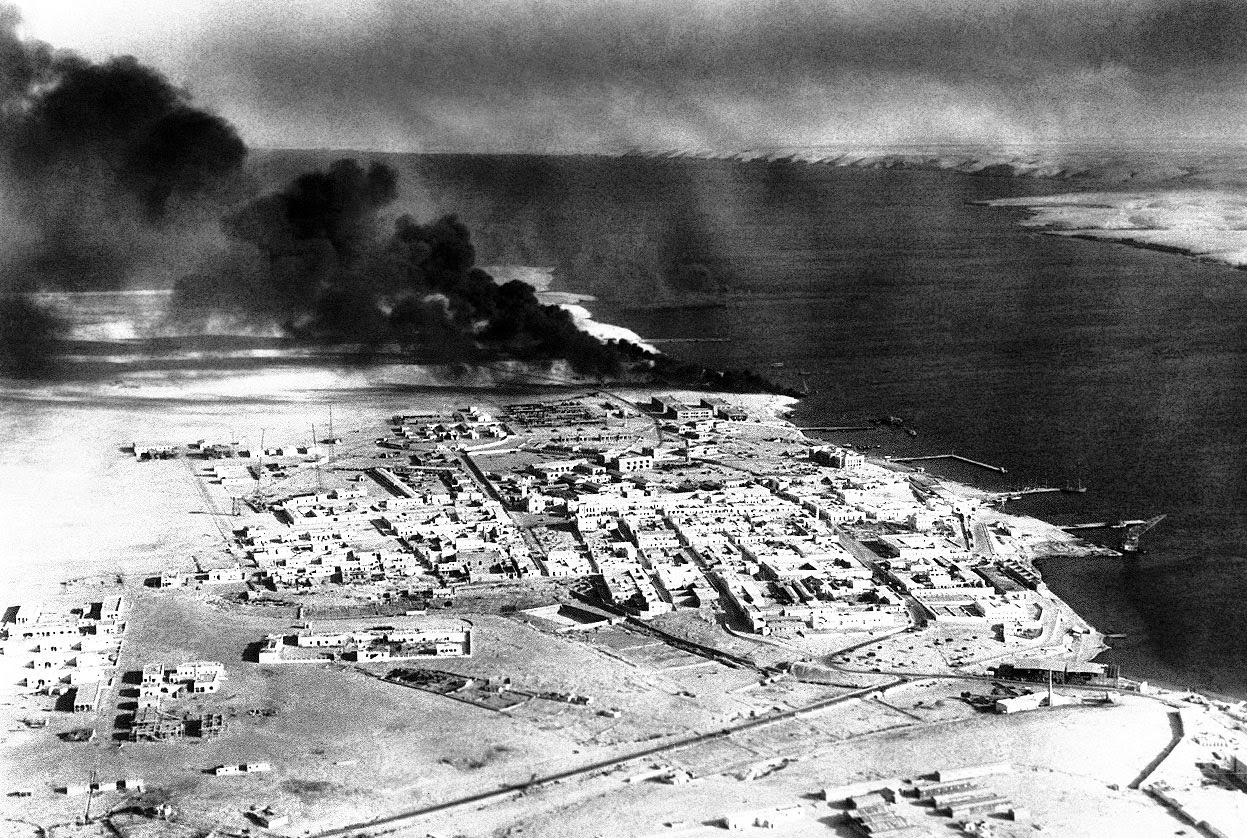
Today in 1941, in Tobruk, Libya

British and Commonwealth forces entered the port city, capturing it and taking tens of thousands of Italian occupiers taken prisoner.

Tobruk's port was more important than the city itself.
Less than a year earlier, Italy had declared war on Great Britain in June 1940. At that time, Gen. Rodolfo Graziani had almost 10 times the number of men in Libya than the British forces in Egypt under Gen. Archibald Wavell, who was commissioned to protect the North African approaches to the Suez Canal. A vast western desert stretched between the antagonists, who sat for months without confrontation. During that time, Italian forces passed into Egypt-but by that point Britain had reinforced its own numbers and decided to make a first strike.
Tobruk would change hands several times during the war.
On December 9, Maj. Gen. Richard Nugent O'Connor launched a westward offensive from Mersa Matruh, in Egypt. Thirty thousand Brits warred against 80,000 Italians-but the British had the advantage of 275 tanks to the Italians' 120. Within three days, 40,000 Italian prisoners were taken. The battle marked the beginning of the end of the Italian occupation of North Africa.

Italian artillery was among the spoils captured by the British.
General O'Connor then began a sweep of Italian positions in Libya. Under his direction in early January 1941, the British 7th Royal Tank Regiment drove westward from Bardia, which it had just taken from the Italians, with the intention of isolating Tobruk until the 6th Australian Division could aid in an assault. The attack on the coastal fortress of Tobruk was finally launched on the 21st and it fell the next day, yielding 30,000 Italian prisoners, 236 guns, and 87 tanks. The 7th Royal Tank Regiment was a remarkable unit, winning a quick series of battles in Libya despite a paucity of resources.
Rommel and the Afrika Korps arrived in the nick of time.
However, the British victory was short-lived as the unrelenting string of Italian catastrophes led Adolf Hitler to the conclusion that the Italian would lose all of North Africa if they were no reinforced by German forces.  Rommel and the Afrika Korps soon arrived.

[January 22, 1941]

Friday, January 16, 2015

Today in 1945, in Berlin, Germany,

Adolf Hitler moved into the Führerbunker.

Der Fuhrer

Hitler would spend the rest of his life), 105 days, in the bunker while overwhelming Soviet infantry and armored forces surrounded and eventually captured the German capital. It became the centre of the Nazi regime until the last week of World War II in Europe. Hitler married Eva Braun here during the last week of April 1945, shortly before they committed suicide.
The bunker as it looked after it was captured by the Soviets
The Führerbunker (English: "Leader's bunker") was an air-raid shelter located near the Reich Chancellery in Berlin, Germany. It was part of a subterranean bunker complex constructed in two phases which were completed in 1936 and 1944. It was the last of the Führer Headquarters
(Führerhauptquartiere) used by Adolf Hitler.
After the war both the old and new Chancellery buildings were levelled by the Soviets. Despite some attempts at demolition, the underground complex remained largely undisturbed until 1988–89. During reconstruction of that area of Berlin, the sections of the old bunker complex that were excavated were for the most part destroyed. The site remained unmarked until 2006, when a small plaque with a schematic diagram was installed. Some corridors of the bunker still exist, but are sealed off from the public.

[January 16, 1945]


Saturday, January 3, 2015

Today in 1945, at Phillippsbourg, France

U.S. Army Private George B. Turner took heroic actions in the European Theater of Operations during World War II leading to the award of the Medal of Honor.

As set forth in the citation for heroism,

Private Turner, U.S. Army

Rank and organization: Private First Class, U.S. Army, Battery C, 499th Armored Field Artillery Battalion, 14th Armored Division.

Place and date. Philippsbourg, France, 3 January 1945.

Entered service at: Los Angeles, Calif. Born: 27 June 1899, Longview, Tex. G.O. No.: 79, 14 September 1945.

Citation: At Phillippsbourg, France, he was cut off from his artillery unit by an enemy armored infantry attack. Coming upon a friendly infantry company withdrawing under the vicious onslaught, he noticed 2 German tanks and approximately 75 supporting foot soldiers advancing down the main street of the village. Seizing a rocket launcher, he advanced under intense small-arms and cannon fire to meet the tanks and, standing in the middle of the road, fired at them, destroying 1 and disabling the second. From a nearby half-track he then dismounted a machinegun, placed it in the open street and fired into the enemy infantrymen, killing or wounding a great number and breaking up the attack. In the American counterattack which followed, 2 supporting tanks were disabled by an enemy antitank gun. Firing a light machinegun from the hip, Pfc. Turner held off the enemy so that the crews of the disabled vehicles could extricate themselves. He ran through a hail of fire to one of the tanks which had burst into flames and attempted to rescue a man who had been unable to escape; but an explosion of the tank’s ammunition frustrated his effort and wounded him painfully. Refusing to be evacuated, he remained with the infantry until the following day, driving off an enemy patrol with serious casualties, assisting in capturing a hostile strong point, and voluntarily and fearlessly driving a truck through heavy enemy fire to deliver wounded men to the rear aid station. The great courage displayed by Pfc. Turner and his magnificently heroic initiative contributed materially to the defense of the French town and inspired the troops about him.


[January 3, 1945]

Friday, January 2, 2015

Today in 1967, in the skies over North Vietnam


With a MIG-21 kill during one of the biggest dogfights of the Vietnam War, US Air Force Colonel Robin Olds became the only ace of both the Vietnam War and World War II.  Colonel Olds was the commander of the 8th Tactical Fighter Wing at the time.

[January 2, 1967]

Tuesday, December 23, 2014

Today in 1948, in Tokyo Japan

Former Japanese premier and chief of the Kwantung Army, Hideki Tojo was executed by hanging with six other top Japanese leaders for their war crimes during World War II.  He was adjudged guilty and sentenced by the International Tribunal for the Far East more than three years after the end of hostilities.  The seven defendants were also found guilty of committing crimes against humanity in regard to their systematic genocide of the Chinese people.

On November 12, death sentences were imposed on Tojo and the six other principals, such as Iwane Matsui, who organized the Rape of Nanking, and Heitaro Kimura, who brutalized Allied prisoners of war. The Tokyo trials leading to the death sentences featured a single chief prosecutor, American Joseph B. Keenan (a former assistant to the U.S. attorney general), but other nations, especially China, contributed to the proceedings, and Australian judge William Flood Webb presided.  Additionally, various tribunals sitting outside Japan judged some 5,000 Japanese guilty of war crimes and more than 900 of those were executed.

Hideki Tojo
Tojo had been a general of the Imperial Japanese Army, the leader of the Imperial Rule Assistance Association, and the 40th Prime Minister of Japan during much of World War II (October 17, 1941 to July 22, 1944). As Prime Minister, he was directly responsible for the attack on Pearl Harbor, which initiated war between Japan and the United States.

[December 23, 1948]
 

Monday, December 22, 2014

Today in 1944, near Bastogne, Belgium

Six days in to what later became known as the “Battle of the Bulge,” attacking German forces called for the surrender of encircled U.S. forces, and General Anthony McAuliffe responded with a one word answer: "Nuts!"

General McAuliffe famously replied, "Nuts!"
On December 16, 1944, the Germans had launched their largest offensive of the war on the Western Front with the dual goals of (1) capturing the Belgian port of Antwerp and (2) driving a wedge between the British and American armies. The town of Bastogne is strategically located at the center of the road network of within the Ardennes Forest and the Germans referred to it as a "road octopus" since the most roads in the area pass through the town. Without its early capture, the offensive would be doomed to failure. Of course, the Allies also realized Bastogne’s importance and General Eisenhower dispatched the 101st Airborne Division to hold the town at all costs.

The Germans enjoyed initial success
Once Bastogne was encircled, the local German commander sought a surrender, ostensibly to minimize further bloodshed but also intended to place the strategic town under German control,  and sent an emissary with the following message,


To the U.S.A. Commander of the encircled town of Bastogne.

The fortune of war is changing. This time the U.S.A. forces in and near Bastogne have been encircled by strong German armored units. More German armored units have crossed the river Our near Ortheuville, have taken Marche and reached St. Hubert by passing through Hompre-Sibret-Tillet. Libramont is in German hands.
There is only one possibility to save the encircled U.S.A. troops from total annihilation: that is the honorable surrender of the encircled town. In order to think it over a term of two hours will be granted beginning with the presentation of this note.
If this proposal should be rejected one German Artillery Corps and six heavy A. A. Battalions are ready to annihilate the U.S.A. troops in and near Bastogne. The order for firing will be given immediately after this two hours' term.
All the serious civilian losses caused by this artillery fire would not correspond with the well-known American humanity.
- The German Commander.

 
The ultimatum made it up the American chain of command until it reached General McAuliffe who sent back the following message,
 
To the German Commander,

Nuts!

- The American Commander.
 

American troops defending the line
The German offensive eventually failed due largely to American resistance around St. Vith, on the northern shoulder of the Bulge, and by American forces holding Bastogne on the southern shoulder of the Bulge. American forces held out until relieved by units of General Patton’s Third Army driving north.

Wednesday, December 17, 2014

Today in 1939, in Montevideo Harbor

The Deutschland class heavy cruiser Admiral Graf Spee was ordered scuttled by her commander, Hans Langsdorff, when he received false reports of approaching British naval forces that likely would have captured her as she lay at anchor in Montevideo harbor.


The Graf Spee, also known as a pocket battleship in the German Kriegsmarine, had battled a trio of pursuing British cruisers and inflicted heavy damage during the Battle of the River Plate. However, she had also suffered significant damage herself and been forced to take refuge in the neutral harbor only to be told by local authorities she would have to get underway and leave within 72 hours.


Admiral Langsdorff and his crew had seen considerable success in putting Allied ships on the ocean bottom, but their luck ran out when she tangled with the British cruisers.  Parts of her superstructure are still visible above the waterline in the Uruguayan harbor.


Many have wondered if the Graf Spee had managed to escape and continued to maraud against Allied shipping for a few more years the damage it inflicted would have affected the outcome of the war, but, just as with speculations over the Bismarck's fate, these will have to  remain conjecture.

[December 17, 1939]

Tuesday, December 16, 2014

Today in 1944 in the Ardennes Forest,


More than a quarter million Germans, some of them wearing captured American uniforms and speaking English, equipped with the latest armored vehicles, including behemoth King Tiger tanks, launched the last major offensive of World War II against the Western Allies.  Eventually known to Americans as the Battle of the Bulge, the sudden German attacks against unprepared American troops already looking forward to a Christmas respite met with initial success and threatened to delay the Allied drive into Germany indefinitely.

German troops advanced past a knocked out U.S. halftrack.
The German attack drove a salient into the Allied lines of almost 70 miles with a width of about 50 miles such that on a map it looked like a "bulge" had appeared in the Allied lines.  The difficulty for the Germans was that even as they attacked and drove deeper into the Ardennes the more they exposed their own flanks to Allied counterattacks.

U.S. troops sit atop a destroyed German Panther tank.
Realizing that he could no longer maintain an active defense on two fronts and understanding that the Soviet Army was likely to achieve a strategic breakthrough that would known Nazi Germany completely out of the war, Hitler hoped that his panzertruppen would be able to drive a wedge between the Americans and the British and cause enough casualties that they would rethink their intentions of destroying the Nazi regime. 

Generals Bradley, Eisenhower and Patton confer.
Historians have long debated whether the Germans had enough men an materiel to realistically have any hope of achieving even a limited version of Hitler's goals, but, in the end, it didn't matter as the Allies were able to contain the German onslaught and, eventually recapture their own positions.  The drive into Germany began in earnest early in 1945.

[December 16, 1944]

Friday, December 12, 2014

Today in 1942, southwest of Stalingrad, Russia

German forces began Operation Winter Storm, the last ditch and ill fated attempt to relieve the encircled 6th German Army under the command of General Von Paulus.


With significant panzer forces and the highly-motivated if exhausted and underfed motivated soldiers of the 6th Army waiting to attack rear elements of the Russian forces facing the relief columns, Army Group Don was destined to fall short in their desperate gambit.


Ultimately, the Germans were unable to link up, the Russians bled their Eastern Front opponents even further, and the 6th Army resigned itself to eventual capitulation and ignominious destruction. 

It's about time The Military Minute made it on to Blogger

Like it, hate it, or indifferent to it, military history is happening all the time.  Leaders are born and die.  Solders enlist, fight, and retire.  Nations prepare for war while trying to avoid war.  It has been going on for longer than you or I have been alive and it will go on long after we're dead. 

Rommel's Afrika Korps was a cutting edge fighting force in 1942
Some aspects of military history, the misery, the agony, the destruction, would be familiar to a combatant of any era while other aspects would be completely foreign.  A Hittitie warrior would have little use for an M1A1 Abrams main battle tank without the knowledge of how to use it and the materiel necessary to make it work.  Similarly, Union and Confederate soldiers at Gettysburg or Antietam would have left English crossbows off the battlefield because they, too, would have been virtually useless against the weapons and tactics of the American Civil War.  And yet, all warriors, especially those who have tasted battle, would prefer the comforts of home to those of the trench or the fortress or the castle. 


The weapons that won the day at the Battle of Hastings would have been useless in World War II.
War has been a necessary evil through most of humanity's existence and in this blog and on the related social media sites, Military Minute will explore as many topics related to military history as possible.  We do not seek to glorify war, as any veteran will tell you glory does not live on any battlefield, but only in the mouths of politicians and the misguided retellings of historians, but we will extoll the virtues of the men and women who have sacrificed their time, effort, and lives for principles they deemed worthy of the sacrifice.  And, we hope that by so doing we may take us all a step, albeit a small one, closer to the objective extolled by the immortal artists Joe Kubert, "Make war no more."